Basement epoxy flooring is one of the most transformative upgrades you can make to a home — turning a cold, dusty slab into a bright, cleanable surface that makes the whole space usable. But basements are more challenging than garages, and the most common reason basement epoxy fails is that someone treated it exactly like a garage install. Here's what's different and what it takes to do it right.
Why basements are a different challenge
The fundamental difference between a garage slab and a basement slab is where they sit. A garage slab is at grade or above it, typically well-ventilated, and exposed to airflow that helps keep moisture levels manageable. A basement slab sits below grade, surrounded by soil that holds moisture year-round, often without an adequate vapor barrier beneath it.
Moisture moves through concrete. Slabs allow water vapor to migrate up from the soil through the slab — a process called vapor transmission. In a garage, this vapor largely dissipates harmlessly. In a sealed basement with a coating on the floor, that vapor has nowhere to go — and it pushes up against the underside of the coating with enough force to lift it off the slab.
This is the cause of the vast majority of basement epoxy failures: bubbling, blistering, and delamination driven by moisture vapor that wasn't properly tested for and addressed before coating.
Moisture testing: non-negotiable for basements
Before any coating goes down on a basement slab, moisture testing is essential. The two standard test methods:
Calcium chloride test (ASTM F1869) — a sealed dish of calcium chloride is placed on the slab for 60–72 hours, and the weight gain is measured to calculate the moisture vapor emission rate (MVER). Most coating manufacturers specify a maximum MVER — typically 3–5 lbs per 1,000 square feet per 24 hours.
Relative humidity probe test (ASTM F2170) — probes are inserted into holes drilled in the slab to measure relative humidity within the concrete. Readings above 75–80% RH typically indicate moisture levels that will cause adhesion problems with standard coatings.
A professional installer should perform one of these tests before coating a basement. If they skip this step, ask why. On a garage, you might get away with it. On a basement, skipping it is gambling with the floor's longevity.
When moisture is present: mitigation options
Elevated readings don't necessarily mean the project can't proceed — they mean the system needs to be specified appropriately:
Moisture-tolerant primers — formulated to bond to slabs with moderate vapor emission rates. These products chemically tolerate some moisture transmission and are the most common solution for basement slabs with moderate readings.
Moisture mitigation systems — for higher emission rates, dedicated two-component moisture mitigation coatings can be installed before the decorative system. Thicker and more aggressive than standard primers.
Drainage and waterproofing — if there's active water intrusion (actual water coming through cracks, not just vapor), coating alone won't solve the problem. The source of water entry needs to be addressed before any floor coating is considered. This is a different scope of work from floor coating.
The key distinction is between vapor transmission (normal, manageable with the right products) and active water intrusion (requires a different solution). A professional installer should help you understand which situation you're dealing with.
Surface prep considerations specific to basements
Basement slabs often have conditions that affect prep:
Existing paint or sealers — many basement slabs have been painted at some point, sometimes decades ago. This needs to be fully removed before coating — grinding over old paint without removing it creates an adhesion problem. The grinding process typically handles this, but old oil-based paints sometimes require more aggressive treatment.
Efflorescence — the white crystalline deposits that appear on concrete surfaces exposed to moisture. Efflorescence is soluble minerals carried to the surface by water and deposited when the water evaporates. It needs to be removed before coating, typically by grinding, as it prevents adhesion.
Cracks from settling — basement slabs are more prone to settling cracks than garage slabs. These need to be evaluated — stable, dormant cracks can be filled and coated; active cracks need more careful treatment.
Radiant heat systems — if the basement has in-floor radiant heat, the coating system needs to be compatible with thermal cycling. Let your installer know, as some products handle this better than others.
Finish options for basements
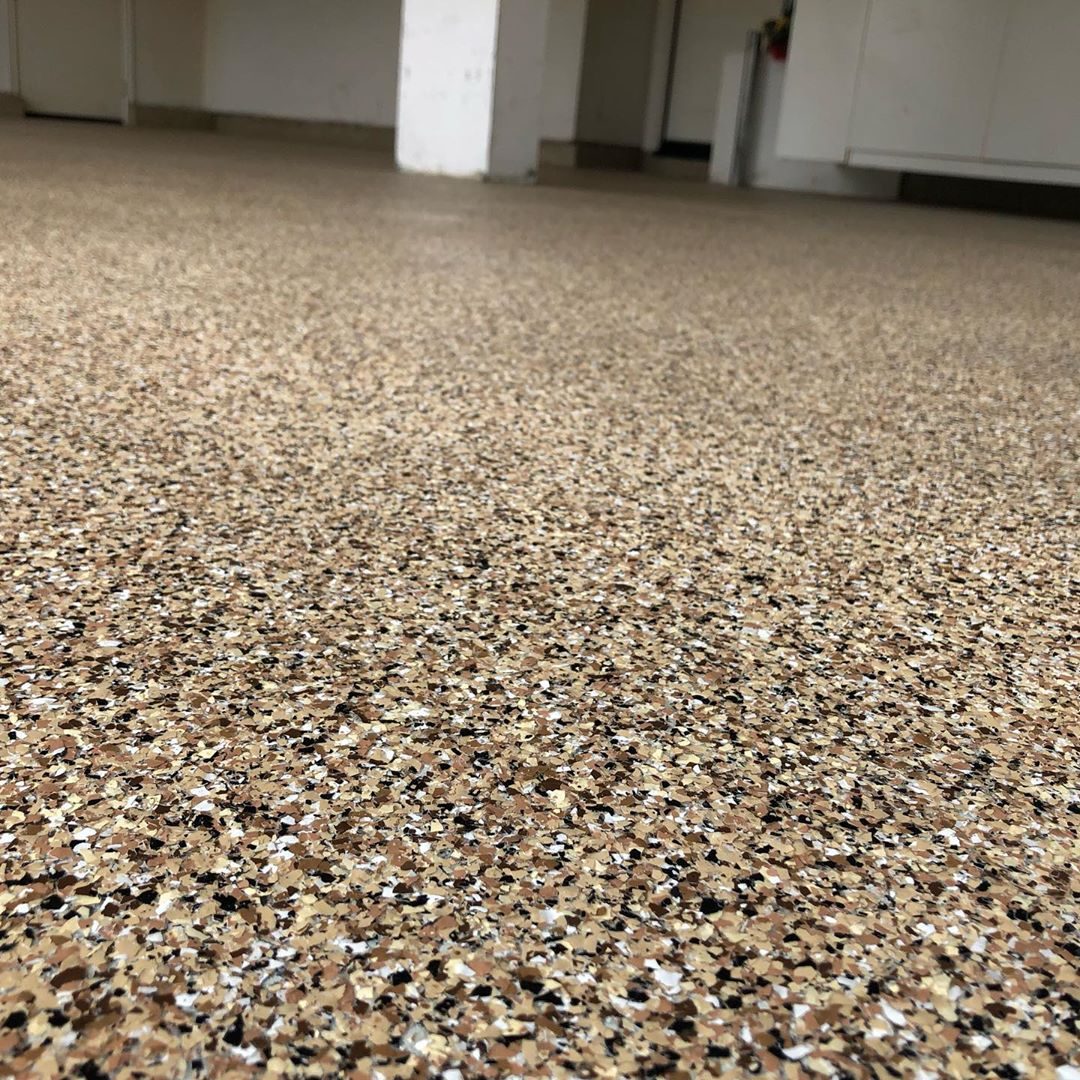
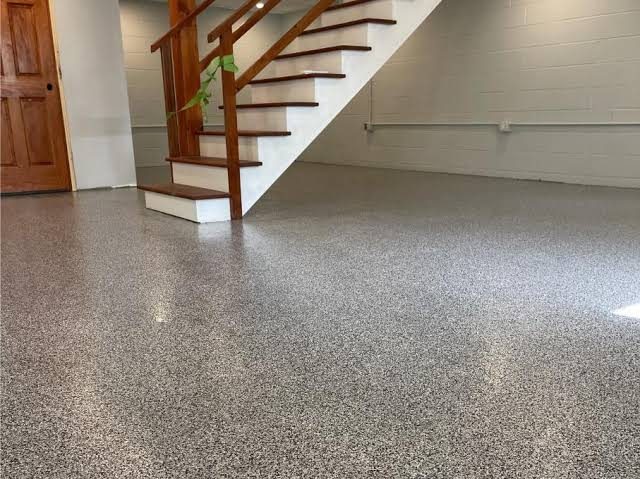
Flake systems are the most popular choice for basements — they hide imperfections and minor surface variation, provide natural texture and slip resistance, and come in a wide range of colors. In a basement used as a gym, playroom, or living space, a neutral flake blend creates a floor that's both attractive and functional.
Solid color works well in utility basements or spaces primarily used for storage. The most economical option with a sealed, easy-clean surface.
Metallic systems can work beautifully in basement spaces converted to finished living areas — home theaters, wine cellars, or high-end recreation rooms where the floor is a design feature.
One practical consideration specific to basements: the finish should account for how the space will be used. A basement gym benefits from a slightly more textured surface. A utility storage area just needs to be sealed and easy to sweep.
Temperature and lighting effects in basements
Basements are typically cooler and darker than above-grade spaces, and both factors affect appearance and installation.
On the appearance side: lighter flake blends and lighter base coat colors make a dramatic difference in a basement's perceived brightness. A dark floor in an already dark space emphasizes the underground feeling; a light gray or warm beige blend reflects more light and makes the space feel significantly more open.
On the installation side: basements run cooler than garages, especially in the Mountain West falls and winters. Cooler temperatures extend cure times and, below about 50°F, can prevent proper curing of standard epoxy products. If your basement runs cold, discuss this with your installer — polyaspartic products with wider temperature tolerances, or supplemental heating during installation, may be needed.
The questions worth asking before a basement install
Do you test for moisture, and what test method? What system do you use for below-grade slabs with elevated moisture? How do you handle efflorescence and old paint? What's the minimum temperature for installation? What does the warranty cover for moisture-related failures? A contractor with clear, specific answers to these questions has done basement floors before and understands what makes them different.
What a successful basement installation looks like long-term
A properly installed basement epoxy floor — with appropriate moisture assessment, the right primer system, good mechanical prep, and a quality topcoat — is genuinely durable. Unlike above-grade floors, basements see relatively light traffic and minimal UV exposure, which means the topcoat tends to age well.
If your basement has had flooring failures before — tile that cracked, carpet that molded, paint that peeled — moisture is almost certainly the reason. The right approach is addressing that moisture first, then installing an appropriately specified coating system. Done in that order, a basement epoxy floor is one of the most durable and satisfying upgrades in the house.