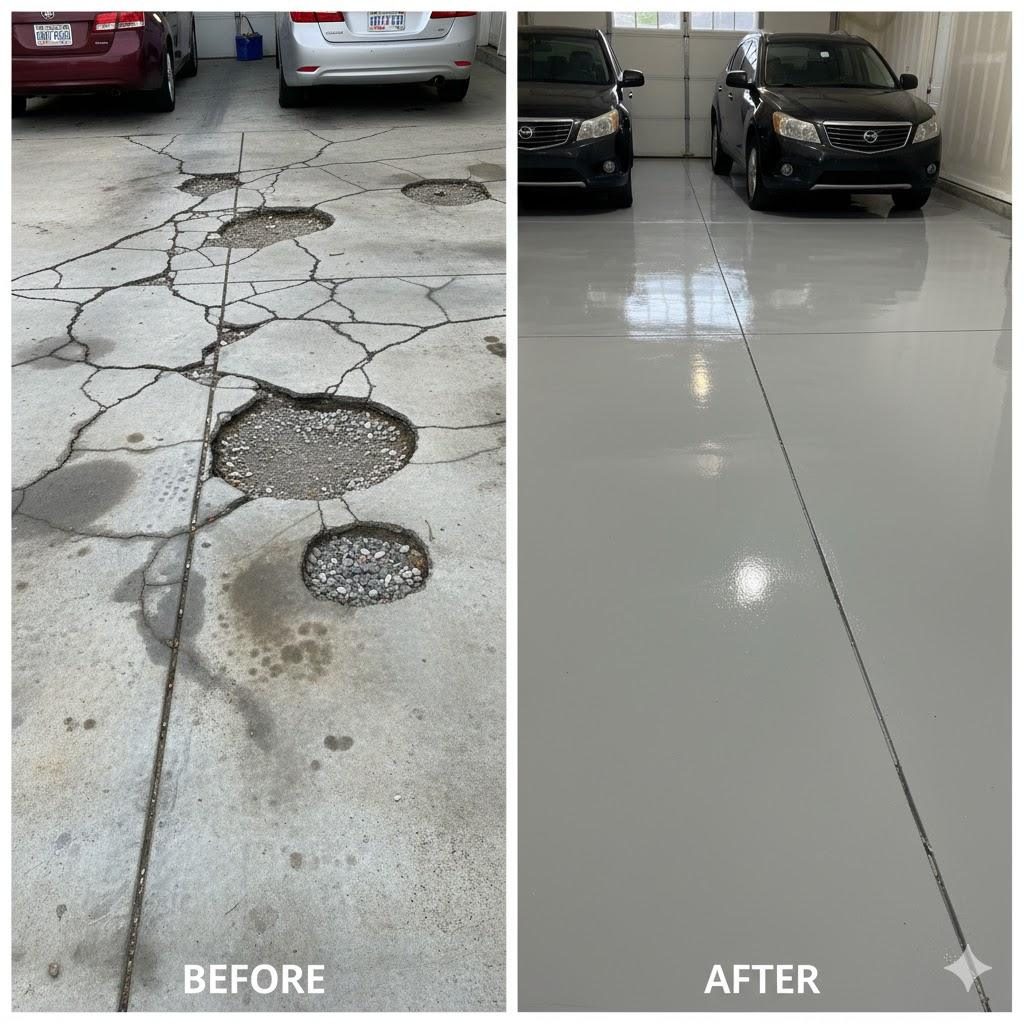
One of the most common concerns before calling about an epoxy floor is the condition of the existing slab. Cracks running across the garage, chunks of concrete missing near the door, oil stains that look permanent, an old paint job lifting in sheets — it's easy to look at a damaged slab and wonder whether it's even worth coating. In most cases, the answer is that it's repairable. What "repaired" means, and what the floor will look like afterward, varies by type and severity of damage.
Cracks: the most common concern
Cracks in concrete slabs are extremely common. Most residential garage slabs crack — it's a function of thermal expansion and contraction, soil settlement, and the curing process. The presence of cracks doesn't disqualify a slab from being coated. How they're treated before coating is what matters.
Dormant cracks (stable, not moving)
A crack that's been stable for years is straightforward to treat. It's first routed with a crack-chasing saw to create a clean, consistent width and remove any loose material at the edges. Then blown out with compressed air and filled with a semi-rigid polyurea or polyurethane filler.
Semi-rigid is the key specification. A rigid filler in a crack that's still subject to minor thermal movement will crack again. A semi-rigid material has enough flexibility to move slightly with the concrete without breaking. After curing, it's ground flush with the surrounding slab, and the coating goes over it. Done correctly, a treated dormant crack is stable and functional, though it may remain slightly visible depending on the finish.
Active cracks (still moving)
An active crack — one that continues to widen or shift — is more complex. Routing and filling gives a cosmetically improved surface, but if the underlying movement continues, the filler and potentially the coating above may eventually re-open. Active cracks warrant investigation into their cause. In many cases the realistic answer is to use a more flexible joint treatment and accept that some hairline cracking at the repair may recur over time.
Control joints
Control joints — the intentional saw cuts that give concrete a place to crack in a controlled location — are a different situation. They exist to allow movement. Filling them rigidly is counterproductive; the slab will push the rigid filler out or crack elsewhere.
Control joint treatment depends on the use and finish. They can be filled with a semi-rigid polyurea, left open and capped with a metal cover, or addressed with a saw-cut and re-fill approach that maintains the joint's function while providing a smooth surface for coating.
Spalling: surface deterioration
Spalling refers to the flaking, pitting, and surface deterioration common near garage door thresholds (where freeze-thaw cycles are most aggressive) and in areas with heavy traffic. Mild spalling without significant depth loss is typically addressed by the grinding process itself, which removes loose, degraded material and exposes sound concrete beneath.
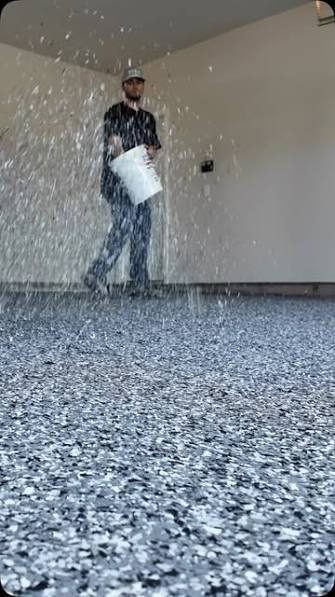
More significant spalling with deeper craters requires patching. Polymer-modified cement mortars and two-component epoxy mortars both work. The patch material is applied into the voids, troweled flush, allowed to cure, then ground. After grinding, patches are typically less visible under a flake system than under a solid color.
Oil and chemical contamination
Oil contamination is the most common prep challenge in residential garages, and genuinely more difficult to address than most people expect. Petroleum products soak into concrete over time, and even old, dried contamination can extend several inches below the surface. A spot that looks like a surface stain may have deep penetration.
The treatment approach: a penetrating degreaser is applied, allowed to dwell, scrubbed in with a stiff brush, and removed — sometimes repeated multiple times for heavily contaminated areas. For severely contaminated areas, mechanical shot blasting (propelling steel shot at the surface at high velocity) is more effective than chemical degreasing alone.
The honest limitation: very deep oil contamination may not be fully addressable. A coating over deeply contaminated concrete may have adhesion problems in those specific spots regardless of prep. For a garage that's been a vehicle leak repository for decades, some risk of localized adhesion issues in the worst spots is real. A good installer tells you this honestly rather than promising perfect results over severe contamination.
Previous coatings
Old paint is common on garage and basement floors. Key scenarios:
- Well-adhered latex paint — can sometimes be coated over after mechanical abrasion, though removal is generally preferable for long-term reliability
- Peeling latex paint — must be removed; it will take new coating with it
- Oil-based paint — generally should be removed due to chemical incompatibility with typical epoxy systems
- Well-adhered existing epoxy — often can be recoated after proper abrasion
- Failed or peeling epoxy — must be removed; grinding off a failed coating and starting with bare concrete is the only path to reliable adhesion
Uneven surfaces and low spots
Slabs out of level can sometimes be addressed with grinding (high spots) or self-leveling underlayment (low spots). However, epoxy is not a self-leveling material and can't compensate for significant floor-level variation. Major leveling is a separate scope of work from coating and should be discussed specifically with your installer.
Minor low spots and undulations — the normal variation in a residential slab — don't need to be addressed before coating. They'll be visible in a solid-color finish in raking light, and much less visible under a flake finish.
What genuinely can't be fixed without replacement
- Structural failure — slabs that have heaved, dropped significantly, or broken into distinct pieces due to soil failure beneath them need structural remediation, not coating
- Active water intrusion through the slab — not moisture vapor, but actual water coming through cracks in significant amounts. Coating won't stop water entry.
- Severely degraded concrete — concrete that has lost significant strength through carbonation or chemical attack may not have enough integrity to hold a coating
The good news for most slabs
The vast majority of residential garage slabs — even ones that look bad — are candidates for coating after proper repair and preparation. Cracks can be treated, spalling patched, oil degreased, old coatings removed. The condition that disqualifies a slab is structural failure or irreparable degradation, which is relatively rare. If you're looking at your garage floor thinking it's too far gone, it's worth having someone look at it before making that call.