If you've had an epoxy floor fail — a kit that started peeling within the first summer, or a professional install that didn't hold up — you're right to be skeptical the second time. Epoxy floors fail for specific, preventable reasons. And if you hire a contractor who does things the same way, you're going to get the same result.
The most likely reason your floor peeled
The statistics are clear: the most likely reason is surface preparation. Specifically, the concrete wasn't mechanically ground before coating. This single factor accounts for the majority of epoxy floor failures.
Epoxy bonds to concrete by penetrating into a prepared surface profile — a slightly rough, open texture that gives the coating something to grip mechanically. Concrete has a tight, sealed surface. Paint or epoxy applied directly to it doesn't have adequate grip. Over time, particularly under thermal cycling and vehicle use, that insufficient bond fails.
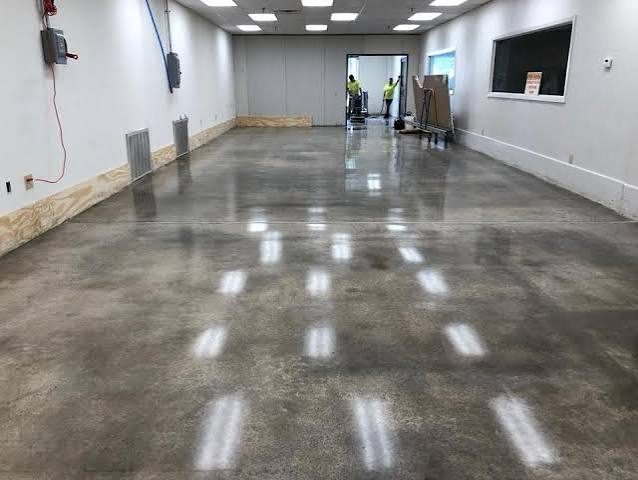
Acid etching — the method used by DIY kits and many budget contractors — sometimes opens the surface, but inconsistently and less thoroughly than mechanical grinding. It doesn't remove curing compounds, previous sealers, or oil contamination. And acid residue actively prevents adhesion. Diamond grinding opens the concrete surface consistently, removes contamination, creates the right texture, and produces a surface that coating can actually bond to. It costs more time and equipment, which is why shortcuts exist. But it's the foundational step everything rests on.
The second most likely reason: moisture
If your floor peeled in bubbles or blisters — particularly starting in the middle of the slab rather than at the edges — moisture is the probable cause. Concrete slabs allow moisture to migrate up from the soil. When that vapor encounters a coating, it has nowhere to go. The pressure builds and eventually lifts the coating from beneath.
The fix: test for moisture before coating, and use a moisture-tolerant primer if readings are elevated. The test takes a few days and costs very little. Installers who skip moisture testing are passing their risk on to you. A contractor who tests and tells you honestly what they found — even if the answer adds cost — is someone who's protecting your floor rather than their margin.
Was it a DIY kit?
DIY kits are thin-film, low-solids products that rely on acid etching. They're not designed for garages that see real use. Most look acceptable for the first summer and begin showing problems — hot-tire pickup, edge peeling, yellowing — within 1–3 years. A failed kit floor has to be professionally ground off before recoating. You end up paying for the kit, the removal, and the proper install. A professional install the first time costs more initially and almost always less total.
What we actually do differently
Diamond grinding, every time. Every floor we install is mechanically ground before any coating is applied. We don't acid etch. We photograph the ground surface as documentation.
Moisture testing before coating. We test every floor before the first coat goes down. If readings are elevated, we discuss the appropriate primer system and explain the tradeoffs. We don't skip it and hope.
Crack and joint treatment. Cracks are routed and filled with semi-rigid filler before any coating. Control joints are treated appropriately — not bridged rigidly. We document what we find and what we did.
Polyaspartic topcoat as standard. Our standard residential system uses a polyaspartic clear topcoat. It doesn't yellow in UV, resists hot-tire pickup better, and has better chemical resistance to road salt and automotive fluids.
Temperature and condition monitoring. We check substrate temperature and ambient conditions before and during application. If conditions aren't within the product's specified range, we adjust or reschedule. We don't apply product in marginal conditions and hope it works.
Written warranty. Every residential installation comes with a written warranty specifying what's covered and for how long.
If you've had a bad experience
The best outcome of a failed epoxy floor is making a more informed decision the second time. If you want to talk through what happened with your previous floor — why it might have failed and what would be different — that's a conversation we're glad to have before any commitment. Understanding what went wrong is the first step to getting it right.
Questions to ask any contractor
- "How do you prepare the floor?" — You want to hear "diamond grinding." Acid etch or a vague answer is a red flag.
- "Do you test for moisture?" — Yes, with a specific test method. "We check by feel" is not adequate.
- "What topcoat do you use, and is it UV-stable?" — A polyaspartic or aliphatic topcoat won't yellow. "Epoxy clear" without specifying aliphatic chemistry will.
- "Do you offer a written warranty?" — Yes, with specific terms. A verbal assurance is not a warranty.
- "Can I see photos of previous work from more than a year ago?" — Day-of photos don't tell you about durability. Ask about floors that are 3–10 years old.