Walk into any conversation about garage or commercial floor coatings and you'll encounter both terms: epoxy and polyaspartic. They're sometimes treated as competitors, sometimes as alternatives, and sometimes as interchangeable — none of which is quite right. Understanding what each one actually is, what it's good at, and where it falls short is the foundation for understanding why quality floor systems are built the way they are.
The chemistry basics (without the textbook)
Epoxy is a thermosetting resin formed by the reaction of an epoxide resin with a polyamine hardener. When the two parts are mixed, a chemical cross-linking reaction begins that gradually produces a hard, rigid, three-dimensional polymer network. Cure time is slow — hours to days depending on temperature and formulation. The resulting material is rigid, strong, and has excellent adhesion to concrete.
Polyaspartic is a specific type of polyurea, which is a sub-class of polyurethane. It's formed by the reaction of an isocyanate with a polyaspartic ester (an aliphatic amine). The chemistry is different enough from epoxy that the materials behave quite differently in practice — particularly in terms of cure speed, temperature tolerance, and UV stability.
You don't need to memorize the chemistry. What matters is what these chemical differences produce in terms of real-world performance.
Where epoxy excels
Bond strength and adhesion
Epoxy's greatest strength as a floor coating is its ability to bond tenaciously to properly prepared concrete. When a slab is mechanically ground to the right surface profile and an epoxy primer is applied, the bond strength exceeds the tensile strength of the concrete itself — meaning the coating won't release from the slab; if something fails, the concrete tears first. This makes epoxy an outstanding base coat and primer.
Film build
Epoxy can be formulated to very high solids content and applied at significant film thickness. High-build epoxy systems — the kind used in industrial and government facilities — can be applied at 20–40 mils per coat and build up a total system thickness that provides real impact and abrasion resistance. Polyaspartic, by comparison, is typically applied in thinner films.
Working time
Epoxy's slower cure is actually an advantage during application. Installers have time to work the product, ensure consistent coverage, broadcast flake evenly, and address any issues before the coating sets. This forgiving working window makes epoxy more suitable for large areas and complex installations.
Cost
Epoxy raw materials are generally less expensive than polyaspartic. For cost-sensitive projects or large industrial areas where square footage is high, epoxy's economics are attractive.
Where epoxy falls short
UV stability
This is epoxy's most significant limitation as a finished floor product: it's not UV stable. Aromatic epoxies — the most common type — will amber, yellow, and chalk when exposed to sunlight. A garage floor that gets direct sun through the door, or any floor near windows, will visibly discolor over time if finished with an epoxy clear coat. This doesn't affect structural integrity, but it absolutely affects appearance.
Cure time
Epoxy is slow. Foot traffic typically requires 12–24 hours; vehicle traffic may require 72 hours or more at standard temperatures. In colder conditions — common in the Mountain West garages in fall, winter, and spring — cure times extend further. A garage that's out of commission for several days is a real inconvenience.
Temperature sensitivity
Most epoxies have a minimum application temperature of around 50°F (10°C) and ideally prefer 60–85°F. Below the minimum, the chemical reaction slows significantly, resulting in incomplete cure, soft films, and adhesion problems. In cold climates, this limits the installation season for unheated spaces.
Where polyaspartic excels
UV stability
Polyaspartic is formulated from aliphatic chemistry, which means it doesn't contain the aromatic components that cause yellowing in epoxy. A polyaspartic clear coat maintains its clarity and color stability essentially indefinitely under UV exposure. This is the primary reason polyaspartic displaced epoxy as the preferred topcoat for garage floors — any floor that sees sunlight needs a UV-stable clear, and polyaspartic delivers that.
Cure speed
Polyaspartic cures dramatically faster than epoxy. Depending on the formulation and temperature, foot traffic may be possible in 2–4 hours; vehicle traffic in 24 hours. This speed is what enables professional installers to complete a full flake floor — prep, base coat, flake broadcast, scrape, seal with polyaspartic — in a single day. For a homeowner who needs their garage back quickly, or a commercial facility that can't afford extended downtime, this matters a lot.
Temperature range
Polyaspartic can be applied at temperatures from near freezing to over 100°F, with specially formulated versions handling even wider ranges. This makes it suitable for year-round installation in climates where epoxy would require waiting for warmer weather — a significant practical advantage in the Mountain West.
Flexibility
Polyaspartic is slightly more flexible than cured epoxy. This flexibility makes it more resistant to cracking under thermal cycling — the expansion and contraction that concrete slabs undergo with temperature changes. For exterior applications or environments with significant temperature swings, this flexibility is a real advantage.
Chemical resistance
Polyaspartic clear coats offer excellent resistance to a wide range of chemicals — fuels, oils, solvents, and cleaning chemicals — that garage floors regularly encounter.
Where polyaspartic falls short
Working time
The flip side of fast cure is a compressed working window. Standard polyaspartic products may start to gel in 20–30 minutes at room temperature, meaning installers need to work efficiently and methodically. Some high-reactivity formulations are even faster. This is manageable for experienced professionals but less forgiving than epoxy's longer open time.
Adhesion to concrete as a standalone primer
Polyaspartic doesn't bond to bare concrete as well as epoxy does. It's an excellent topcoat over a prepared epoxy system, but using it as the sole primer and base coat requires very careful surface preparation and specific product formulations. Most quality installations use epoxy as the primer/base for its superior concrete adhesion.
Cost
Polyaspartic materials cost more per unit than comparable epoxy products. This difference is offset by the labor savings from faster cure (one-day installs rather than multi-day), but the raw material cost is higher.
The hybrid system: why most quality floors use both
Here's the insight that ties this whole comparison together: the best residential and commercial floor systems don't choose between epoxy and polyaspartic — they use both strategically, assigning each product to the role it's best suited for.
A typical quality flake floor system looks like this:
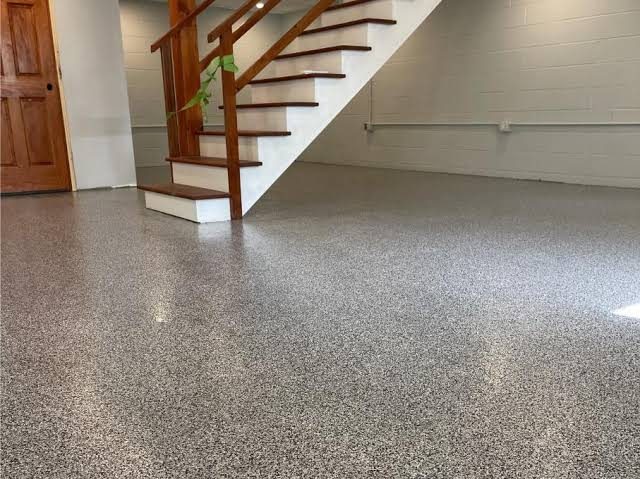
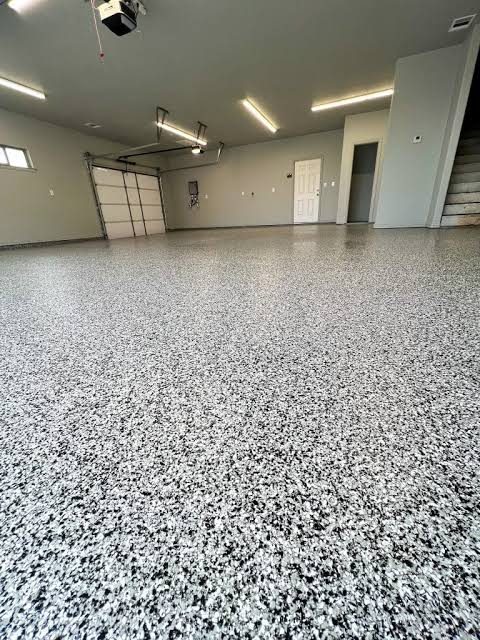
- Epoxy primer/base coat — applied to the mechanically prepared concrete. Epoxy's superior adhesion bonds the system firmly to the slab. The base coat is pigmented to complement the flake color.
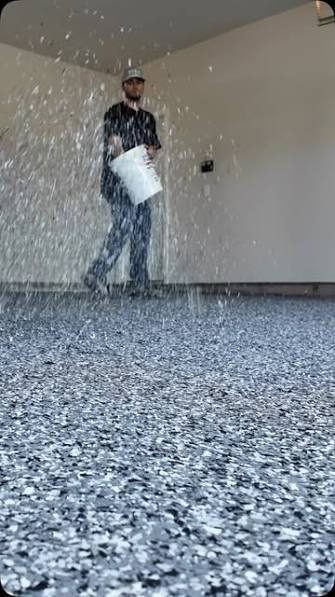
- Flake broadcast — vinyl color flake is broadcast into the wet base coat and allowed to cure.
- Polyaspartic topcoat — applied over the cured, scraped flake layer. Provides UV stability (no yellowing), fast return to service, abrasion and chemical resistance, and a durable wearing surface.
This hybrid approach gets you epoxy's unmatched concrete adhesion and build properties as the foundation, and polyaspartic's UV stability and performance characteristics as the surface you live on. The whole is genuinely better than either product alone.
What to look for in a specification
When reviewing a quote or talking to a contractor, ask specifically what products are being used at each stage and why. A quality contractor should be able to tell you: the base coat product and why it was chosen, whether the topcoat is UV-stable (it should be polyaspartic or aliphatic polyurethane, not aromatic epoxy), and the cure schedule. Vague answers about "epoxy" or "polyaspartic" without stage-specific detail suggest the contractor may not fully understand the system they're selling you.
Common questions
Is a "polyaspartic floor" always better than an "epoxy floor"?
Not necessarily. "Polyaspartic floor" and "epoxy floor" are marketing terms that don't tell you much about the actual system. A quality epoxy system with a polyaspartic topcoat outperforms a single-component polyaspartic applied to a poorly prepared slab. System quality and installation quality matter more than any single product choice.
Can polyaspartic be used as a standalone floor?
Yes, with the right formulation and very careful surface preparation. Some installers use a fast-cure polyaspartic as both base and topcoat for efficiency. The results can be excellent. But most professionals still prefer the two-step approach for the bond assurance that an epoxy primer provides.
Will a polyaspartic topcoat really not yellow?
Quality aliphatic polyaspartic products are genuinely UV-stable and won't yellow under normal sun exposure. This is one of the most important reasons to specify a named polyaspartic topcoat rather than accepting whatever clear coat a budget installer uses.