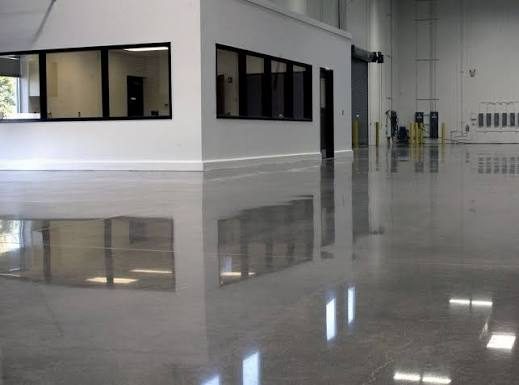
Epoxy coatings and polished concrete are the two heavyweights of hard flooring. Both turn bare, dusty concrete into a surface that lasts for decades — but they get there in completely different ways, and the right choice depends heavily on how your space is used, the condition of your slab, and what you want the floor to look and feel like five or ten years from now.
This guide covers everything you need to make an informed decision: how each system works, where they each perform best, how they compare on cost and maintenance, and the questions worth asking before you commit to either one.
What epoxy flooring actually is
Epoxy is a two-part coating system — a resin and a hardener — that when mixed together undergoes a chemical reaction and cures into a hard, rigid, plastic-like layer bonded to the concrete beneath it. It's applied wet, which means it fills minor surface voids and bonds into the profile of the prepared slab.
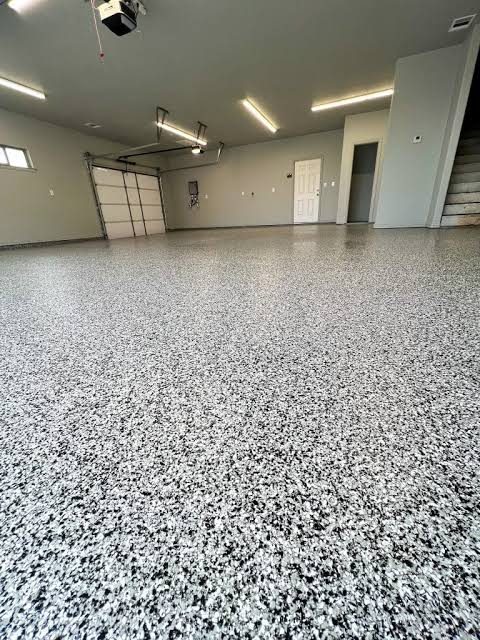
Professional epoxy floors are almost never just a single coat. A properly built system typically includes a penetrating primer or base coat that bonds to the concrete, an optional mid-coat or broadcast layer where decorative elements like flake or metallic pigment are added, and a clear protective topcoat — usually polyaspartic these days — that provides the UV stability, abrasion resistance, and final sheen. The total system thickness on a quality residential floor might be 20–30 mils; industrial systems can be built much thicker.
Because it's a coating sitting on top of the concrete, epoxy gives you enormous design flexibility. Solid colors, multi-tone vinyl flake blends, shimmering metallics, terrazzo-look systems — these are all achievable with epoxy-based products. It also creates a completely sealed, non-porous surface: nothing soaks in, which is a massive practical advantage in garages, shops, and food-service environments.
What polished concrete actually is
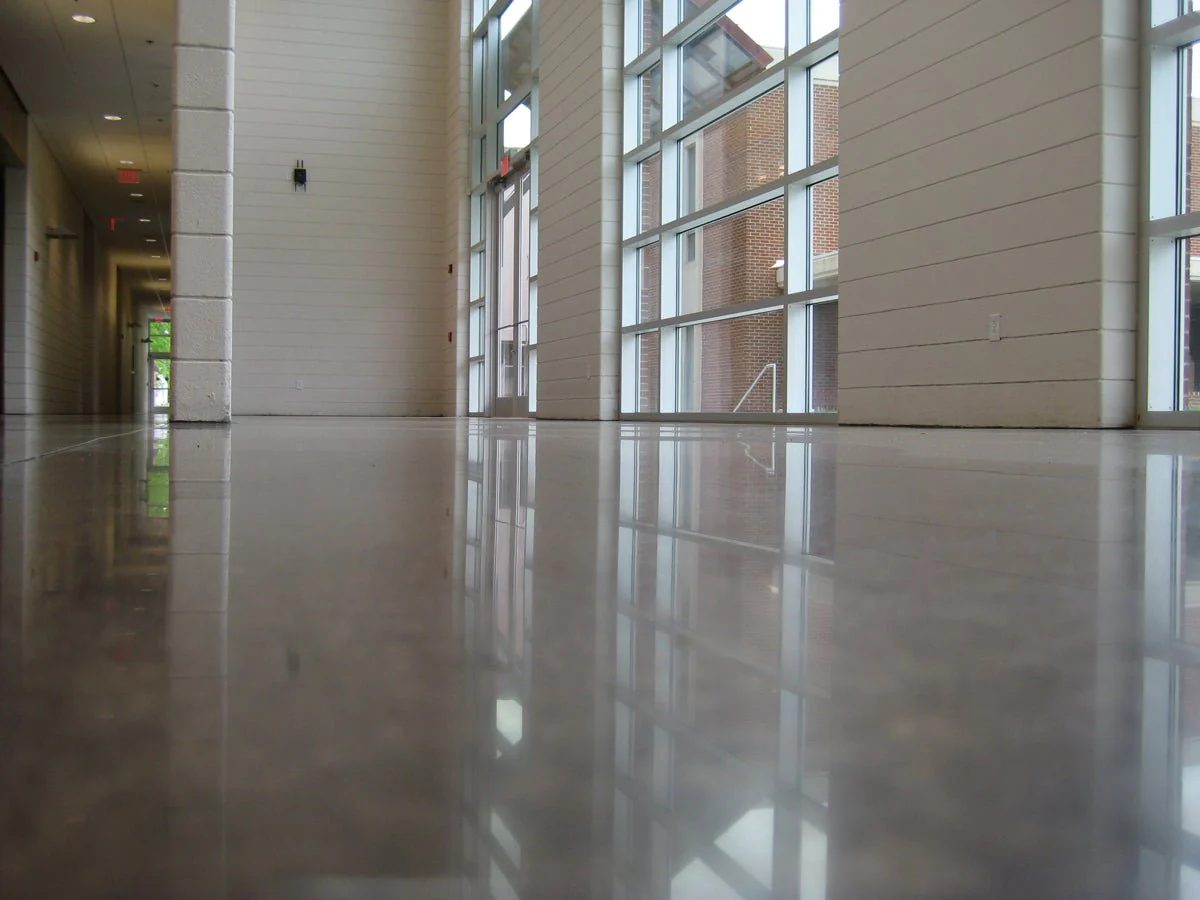
Polished concrete is a fundamentally different approach. Rather than applying anything to the slab, the polishing process uses progressively finer diamond-tooled grinding heads to mechanically refine the surface of the concrete itself. Along the way, a chemical densifier — typically a lithium or sodium silicate compound — is applied and penetrates into the slab, reacting with the calcium hydroxide in the concrete to form additional calcium silicate hydrate. The result is a harder, denser, more impermeable surface than the original slab.
There is no coating in true polished concrete. The shine comes from the refined, densified concrete itself, and it doesn't peel, chip, or delaminate because there's nothing adhering to anything. It's the floor equivalent of polishing stone — you're revealing and refining what's already there rather than covering it.
The grit sequence matters a lot. A floor taken to 400 grit looks very different from one taken to 1,500 or 3,000 grit. Low-grit "honed" finishes are flat and matte with a subtle sheen; high-grit "highly polished" finishes are deep, reflective, and almost wet-looking. You choose the gloss level based on the look you want and the light conditions in the space.
The prep question — and why it matters for both
Both systems start with the same critical step: diamond grinding the concrete surface. For epoxy, grinding opens the surface profile so the coating can mechanically bond. For polishing, grinding is the first step in the finishing sequence itself.
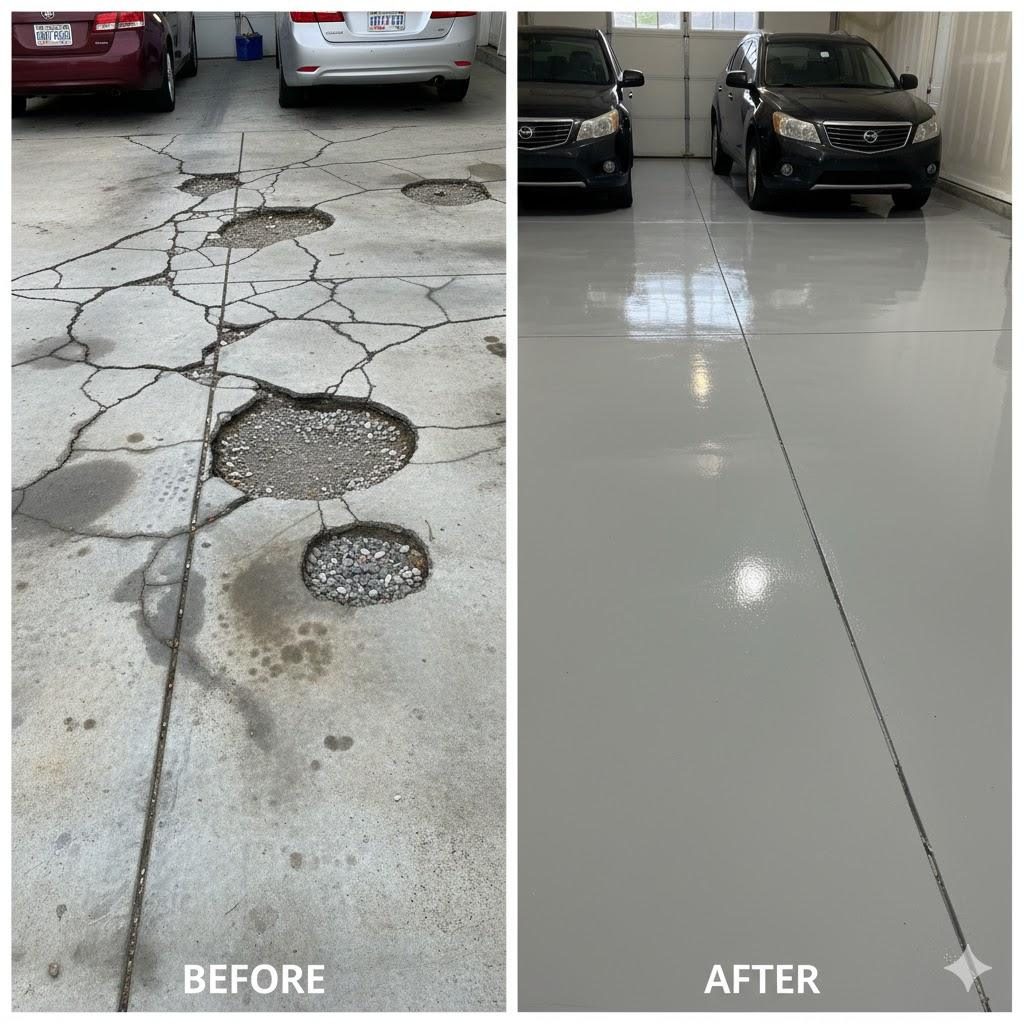
This shared starting point is important because it means the condition of your slab affects both options equally. Deep cracks, spalling, previous coatings, moisture issues, contamination from oil or chemicals — all of these have to be addressed before either system can be applied. The difference is that epoxy can hide minor surface imperfections while polished concrete will reveal and even highlight them.
Durability: how they compare over time
Both finishes are extremely durable when properly installed, but they age differently and fail differently.
Polished concrete is arguably the more bulletproof long-term option. Because there's no coating, there's nothing to peel, chip, or delaminate. The densified surface hardens with age and gets harder and more resistant over time with proper maintenance. The main failure mode is surface abrasion — over years, the microscopic peaks of the polished surface can be worn down by heavy foot and vehicle traffic, reducing the gloss. This is fixable with a re-burnish, which is far less involved than recoating.
Epoxy systems are highly durable but do have a finite topcoat lifespan in high-wear areas. A well-installed residential garage floor with a quality polyaspartic topcoat should look good for 10–20 years with normal use. Hot tires, heavy dragging, and harsh chemicals accelerate wear. When a topcoat does wear out, the good news is that it can usually be cleaned and recoated without removing the entire system — you're just refreshing the protective layer, not starting over.
Appearance: choosing the right look
This is where the two options diverge most dramatically.
Epoxy gives you a blank canvas. Any color in the spectrum is achievable, and decorative systems — flake, metallic, quartz — add texture, depth, and character that bare concrete can't replicate. The surface is uniform and consistent because you're applying something new on top. If you want a bold color, a specific brand color, or a floor that looks nothing like concrete, epoxy is your tool.
Polished concrete reveals and celebrates the existing slab. The aggregate in the concrete, the natural color variation, the occasional crack or historical mark — these become part of the finished look. It always reads as refined concrete, not as a manufactured surface. You can add color with penetrating dyes and stains, and you can control how much aggregate is exposed by adjusting how deeply you grind, but the result will always have that honest, industrial character that's either exactly what you want or not what you want at all.
Cost comparison
This is harder to generalize than most guides suggest, because both systems have a wide range depending on specifics. A few honest factors to understand:
For polished concrete, cost is driven by the starting condition of the slab, the grit level you want (more polishing steps cost more), whether dye or stain is involved, and the square footage. Large, open slabs in good condition are where polishing is most economical — there's very little edge work and the machines move efficiently. Small spaces, complex layouts, and slabs in poor condition push the cost up.
For epoxy, cost is driven by the system complexity (solid color vs. full flake vs. metallic), the amount of prep and repair required, and the topcoat choice. A basic solid-color residential install is one of the more economical floor options available. A full metallic system in a showroom is a premium investment.
Over a full lifecycle, polished concrete often comes out ahead for large commercial spaces because there's no recoating — just periodic maintenance. For garages and smaller spaces, the difference is less significant.
Maintenance: day-to-day realities
Both finishes are famously low-maintenance compared to almost any other floor type, but they have different ongoing needs.
Polished concrete requires dust mopping regularly (grit is its main enemy), damp mopping with a pH-neutral cleaner, and periodic re-burnishing to restore shine in high-traffic areas. No recoating, no waxing, no stripping cycles — ever. The catch is that acidic cleaners, even mild ones like vinegar, will etch and dull the polish over time.
Epoxy wipes clean because nothing penetrates the sealed surface. Oil, chemicals, road salt, and spills sit on top until you mop them up. The main maintenance considerations are keeping grit swept up (it scratches the topcoat over time), using pH-neutral cleaners, and placing mats under jack stands and heavy equipment to prevent point-load damage.
The honest recommendation
For most garages and residential spaces, a quality flake epoxy system delivers the best combination of looks, durability, slip resistance, and value. For large commercial or industrial spaces with a sound slab where long-term maintenance cost matters, polished concrete is often the smarter investment. For food service, chemical environments, and washdown areas, a resinous epoxy or urethane cement system is almost always the right call. The best floor for your space depends on factors specific to your slab and use — which is exactly what a good on-site estimate is designed to figure out.
Questions to ask before you decide
- What condition is the slab in? Heavily cracked or pitted concrete is better suited to epoxy, which can hide imperfections. A clean, sound slab is a better candidate for polishing.
- Is there a moisture problem? Both systems need moisture assessment, but high vapor emissions need specific mitigation products that affect cost.
- How much traffic and what kind? Forklifts and pallet jacks over large areas? Polish is proven. A two-car garage with occasional hot tires? Flake epoxy.
- Do you want a specific color or decorative look? Epoxy gives you options polishing can't match.
- What's the maintenance budget over 10 years? Polished concrete's lower maintenance cost can justify a higher upfront price in large facilities.
If you're still weighing the two for a specific space, the most useful thing you can do is have someone walk the slab and give you an honest assessment of which system it's better suited for. We do that as part of every estimate — and we'll tell you straight which direction makes more sense, even if it's the cheaper one.