Polished concrete has traveled a long way from its industrial origins. Once found primarily in warehouses and distribution centers, it now appears in flagship retail stores, Michelin-starred restaurants, modern homes, government buildings, and university corridors. It's prized for a combination of attributes that's hard to find in a single floor system: striking appearance, extreme durability, very low maintenance, and a lifecycle cost that tends to beat almost every alternative over time.
This guide covers everything worth knowing: what the process actually involves, how to understand the grit and gloss scale, the role of densifiers, color options, maintenance requirements, where polished concrete is the right choice, and where it isn't.
What polished concrete is — and isn't
Let's start by clearing up a common misconception. Polished concrete is not a coating. Nothing is applied to the surface and left there. The process uses progressively finer diamond-tooled grinding heads to mechanically abrade and refine the surface of the existing concrete slab, while a chemical densifier is worked into the concrete during the process to harden it from within.
The finish that results is the concrete itself — just a much harder, denser, more refined version of it. Because there's no film coating on top, there's nothing to peel, bubble, or delaminate. The floor's durability is the concrete's durability, enhanced.
This is the key distinction that drives most of polished concrete's practical advantages: low maintenance, no recoating cycle, no coating failure modes.
The polishing process in detail
A full polishing job typically moves through these stages:
Stage 1: Coarse grinding
The process begins with coarse diamond tooling — often 30 or 40 grit — to remove any existing coatings, open the concrete surface, level high spots, and cut down to a consistent plane. This is the most aggressive step and generates the most material. The depth of grinding at this stage also determines how much aggregate is exposed in the final floor: grinding shallowly reveals mostly the cement paste and sand; grinding more deeply reveals the stone aggregate, creating a terrazzo-like appearance.
Stage 2: Crack and joint repair
After initial grinding, cracks, spalls, and voids are filled with a semi-rigid or rigid filler (color-matched where appearance is important). Control joints may be filled or left open depending on the specification. This step is done before the floor gets finer and finer because subsequent grinding passes will knock down and blend the filler into the surrounding surface.
Stage 3: Progressive honing
The floor moves through a sequence of progressively finer grits — typically 80, 150, 400 — with each pass removing the scratch pattern from the previous one and refining the surface further. The floor gets noticeably smoother and begins to show reflectivity at this stage.
Stage 4: Densifier application
At some point in the grit sequence — typically around the 200–400 grit range — a chemical densifier is applied. Lithium silicate is the most common modern densifier; sodium and potassium silicates are also used. The densifier penetrates into the concrete and reacts with the calcium hydroxide present in the cured cement to form additional calcium silicate hydrate — the same compound that gives concrete its fundamental hardness. This reaction makes the surface measurably harder and more resistant to abrasion and staining. It also improves the grinding behavior at subsequent steps, allowing the diamonds to cut more cleanly.
Stage 5: Fine polishing
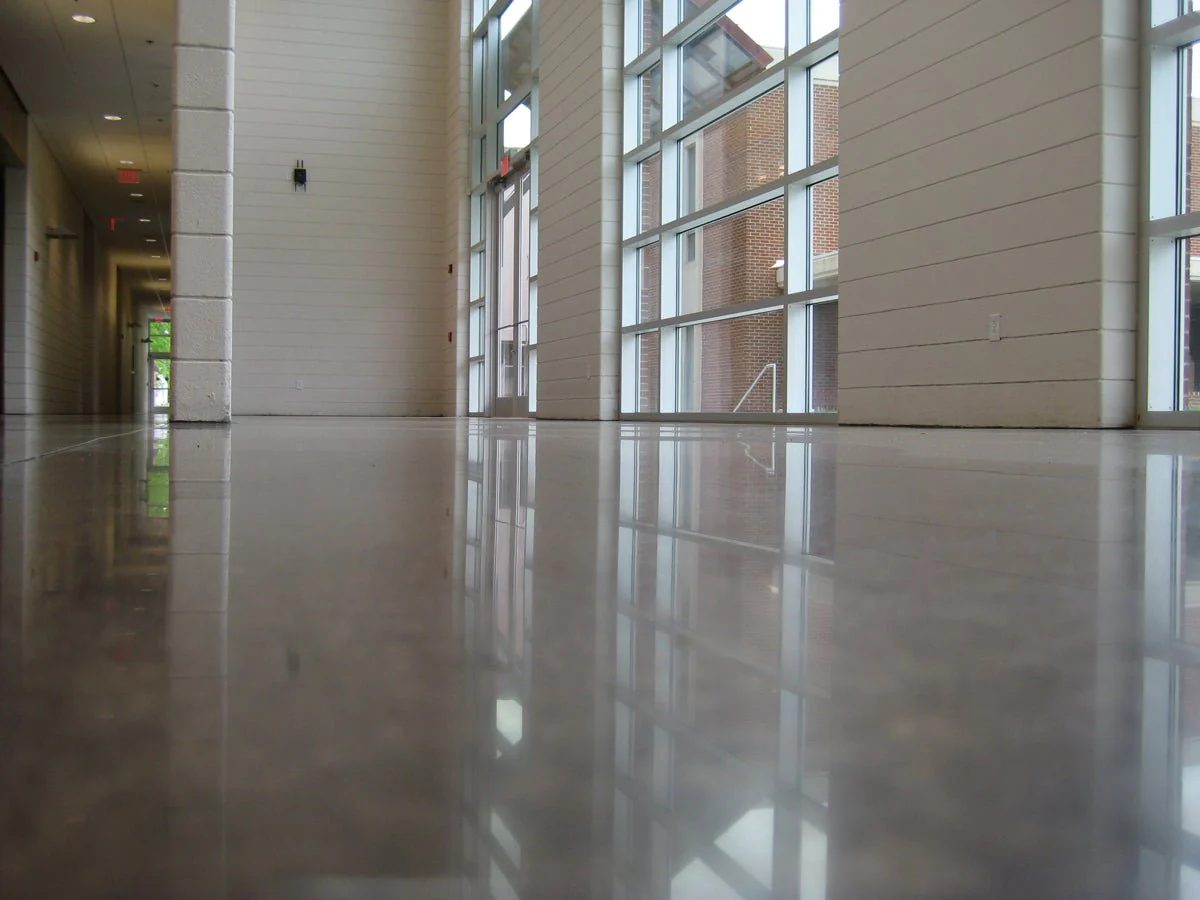
After densification, the floor moves into the polishing grits: 800, 1,500, 3,000. These steps remove microscopic scratches and develop the final sheen. At 800 grit you have a clear, reflective surface with some depth. At 3,000 grit you have a high-gloss, mirror-like finish that reflects ceiling lights sharply.
Stage 6: Guard application
Most polished concrete projects finish with an application of a penetrating concrete guard — a stain-repelling treatment that soaks into the densified surface and provides protection against liquids without forming a surface film. This is different from a topical coating; the guard lives in the surface rather than on it, and doesn't affect the appearance or create a maintenance cycle.
Understanding grit levels and gloss
The grit you stop at determines the final appearance. Here's what each level looks like in practice:
Ground/honed (up to 200 grit) — flat, matte finish with very little reflection. Clean and industrial. Great for spaces where slip resistance is a priority or where a minimalist aesthetic is desired. Common in breweries, production floors, and some retail.
Semi-polished (400 grit) — beginning to show reflectivity, a soft glow rather than a clear reflection. The ceiling is visible but distorted. A popular middle ground that looks refined without being flashy.
Polished (800–1,500 grit) — clear reflections, good depth, the look most people picture when they think of polished concrete. Lights and objects reflect recognizably. This is the most common specification for retail, offices, and public spaces.
High polish (3,000 grit) — deep, wet-looking mirror finish. Ceiling fixtures reflect sharply. This is the showroom-quality finish that brightens spaces dramatically and makes a strong design statement. It requires the most steps and commands the highest price.
Exposing aggregate: the terrazzo effect
One of polished concrete's design variables that surprises people is the degree of aggregate exposure. Concrete contains stone aggregate — the gravel mixed into it during batching. By grinding more or less deeply at the initial coarse stage, you can control how much of that aggregate appears in the finished floor.
Cream finish — minimal grinding, only the top paste layer polished. The floor shows mostly the cement paste and fine sand. Smooth, uniform color.
Salt and pepper — slightly more grinding reveals the fine aggregate and some of the larger stones. A flecked appearance, similar to granite.
Full aggregate exposure — significant grinding reveals the large stone aggregate prominently. The floor looks like terrazzo or polished stone. Very striking when the aggregate is attractive.
The aggregate in your specific slab determines what a fully exposed floor looks like — some slabs have beautiful river stone, others have unremarkable crushed limestone. A good polishing contractor can tell you what's under your floor after the initial grinding pass.
Color: dyes, stains, and natural variation
Polished concrete doesn't have to be gray. Several approaches to color are available:
Penetrating dyes — water- or solvent-based dyes that penetrate the densified surface and add translucent color while preserving the natural variation and aggregate of the concrete. Dyes come in a wide range of colors and can be layered and blended. Because they're translucent, the concrete's natural character shows through.
Acid stains — reactive stains that chemically bond with the minerals in concrete, producing mottled, variegated, often earthy tones. Acid stains produce a range of outcomes depending on the concrete chemistry — the results are somewhat unpredictable and always unique. Browns, tans, greens, and russet tones are typical.
Water-based stains — more uniform color than acid stains, available in a wider range, more predictable results. Less reactive than acid, still penetrating.
One important note: any color treatment for polished concrete is transparent to translucent, not opaque. You're tinting the concrete, not painting it. The floor will look like colored concrete, not like a painted surface — which is either exactly the character you want or not what you're after.
Where polished concrete excels
There are specific environments where polished concrete is an almost unbeatable choice:
- Large commercial and industrial spaces — warehouses, distribution centers, manufacturing plants. The lifecycle cost advantage over coatings is significant at scale, and the durability under heavy equipment is proven.
- Retail and showrooms — the light-reflective quality of a polished floor brightens merchandise and reduces lighting costs. The floor "reads" expensive and well-maintained.
- Public and institutional buildings — schools, government buildings, corridors. No recoating cycle means dramatically lower maintenance costs over a building's life.
- Modern residential — open-plan homes with radiant heating, contemporary architecture, or a preference for honest materials. A polished concrete floor in a well-designed home is a genuinely beautiful thing.
- Spaces with sound slabs in good condition — the better the starting slab, the better the finished floor, and the less the process costs.
Where polished concrete isn't the right choice
Being honest about limitations is part of giving useful advice:
- Spaces that need a specific solid color — polished concrete always reads as concrete. If you want bold color or a non-concrete appearance, an epoxy system is more appropriate.
- Heavily damaged slabs — significant cracking, spalling, or surface damage can be repaired before polishing, but extensive repairs affect the final appearance and add cost. At some point, a coating system may be more practical.
- Commercial kitchens and food service — polished concrete is reasonably cleanable but not as impervious to fats, acids, and thermal shock as a urethane cement or resinous system. Those environments have specific coating requirements for a reason.
- High-moisture environments — while polished concrete is more moisture-tolerant than coatings, very wet environments may benefit from a sealed system.
The slab tells the story
More than almost any other floor system, the outcome of polished concrete depends on the starting slab. Before committing to polished concrete, a good contractor will assess the slab's condition, identify any problem areas, tell you what aggregate exposure is realistic, and give you an honest picture of what the finished floor will look like. If you're considering polishing, that site visit is the single most valuable step in the process.
Maintenance: what "low maintenance" actually means
Polished concrete's reputation for low maintenance is well-earned, but it doesn't mean zero maintenance. Here's what ongoing care looks like:
Daily/weekly — dust mop or auto-scrub to remove abrasive grit. This is the most important habit for preserving the polish because fine grit acts like sandpaper under foot and vehicle traffic.
Damp mopping — pH-neutral cleaner and water as needed. Auto-scrubbers with soft pads work well in commercial settings. Never use acidic cleaners — vinegar, citrus, or general-purpose cleaners with acidic formulations will etch and dull the polish over time.
Periodic re-burnishing — in high-traffic areas, the microscopic peaks of the polish are gradually worn down. A periodic pass with a high-speed burnisher and the right pad restores the shine. Frequency depends on traffic — some facilities do it weekly, others annually.
Guard reapplication — the penetrating guard applied at installation gradually depletes in high-traffic areas. Periodic reapplication (typically every 1–3 years depending on use) maintains the stain resistance of the surface.
No stripping. No waxing. No recoating. Over a 20-year building lifecycle, that maintenance simplicity is worth a significant amount of money.